LLM Nomic Simulation  ·  Case Study

When AI Agents
Rewrite the Rules

In this manually run Nomic simulation, AI agents repeatedly amended the scoring rule. Yes-vote bonuses encouraged cooperation, but also let trailing players catch up quickly — turning the final turn into a decisive swing.

1 Game
2 Rounds
3 Agents
Background

What is Nomic?

Nomic is a game where the rules themselves are up for debate. Every turn, one player proposes a rule change — all players vote, and if a majority approves, the rule takes effect immediately.

The original game

Nomic was invented by philosopher Peter Suber in 1982 as a thought experiment about self-referential rule systems. In the original version, players propose and vote on any kind of rule change — including changes to the voting procedure itself. The ruleset evolves continuously as the game is played, making Nomic both a game and a study in how rule systems govern themselves.

Read the original Nomic rules →

Our version

We used a simplified Nomic designed for LLM simulation. Key differences:

  • Fixed turn limit. 3 agents × 2 rounds = 6 turns total. Prevents unbounded games and keeps sessions manageable.
  • Structured proposals. Agents submit JSON with an optional mechanical_effects field. Rule changes are machine-readable — never inferred from English text.
  • Moderator validation. The engine enforces hard constraints and rejects structurally invalid proposals before voting begins.
  • Immutable rules. Three hard constraints — game termination, no code modification, moderator authority — cannot be changed by any proposal.
  • Explicit mechanics. Vote thresholds and point values only change when a proposal explicitly encodes them in mechanical_effects.

These changes make the game easier to simulate, easier to analyze mechanically, and safer to run with hard constraints that agents cannot override.

Final result

Carter & Blake tied — Alex finished third

Player Model Passed Failed
Carter GPT‑5.4 Extended Thinking 2 0
Alex Claude Sonnet 5.4 Low 1 1
Blake GPT‑5.4 Standard 1 1

The game ended in a tie between Carter and Blake, both finishing with 36 points. Alex finished third with 26 points.

Carter built an early lead with two cooperative scoring proposals that both passed. Alex nearly caught up on turn 5 after increasing the yes-vote bonus to 8 points, gaining 18 points in a single turn.

Blake had scored nothing after the first three turns. On the final turn, Blake proposed a proposer reward increase from 10 to 15 points. With the 8-point yes-vote bonus already in place, this earned Blake 23 points in one move — enough to tie Carter and finish joint first.

Game narrative

Turn-by-turn story

Two rounds, three players, six turns. Each player proposed once per round. Use the buttons below to navigate between rounds.

Player analysis

Player behavior

Three players, three distinct strategies. Carter optimized for passing proposals. Alex and Blake voted cooperatively but proposed ambitiously.

Carter GPT-5.4 Extended Thinking

Carter was the most effective proposer. Both of Carter's proposals passed, giving Carter a 100% proposal pass rate. Carter's strategy focused on increasing rewards for supporting successful proposals. This helped Carter gain an early lead and encouraged other players to support cooperative scoring changes. However, Carter became more defensive after gaining the lead. Carter voted against proposals that would help trailing players catch up, especially Alex's attempt to increase the yes-vote bonus from 5 to 8. Carter's play shows a clear shift from early cooperation to lead protection.

Important note: Carter voted no on Alex's turn-5 bonus increase and yes on Blake's final-turn proposal, perhaps anticipating future turns that never came.
Alex Claude Sonnet 5.4 Low

Alex had a mixed performance. Alex's first proposal failed because it attempted to double the proposer reward from 10 to 20, which the other players saw as too aggressive. However, Alex's second proposal passed because increasing the yes-vote bonus from 5 to 8 benefited both Alex and Blake, who were trying to catch Carter. Alex's strongest move was turn 5. By passing the yes-vote bonus increase, Alex gained 18 points and nearly caught Carter. However, Alex lost ground on the final turn by voting no on Blake's successful proposal, meaning Alex missed out on the final 8-point yes-vote bonus.

Blake GPT-5.4 Standard

Blake had the biggest comeback. Blake started slowly and had no points after the first three turns. Blake's first proposal, which attempted to raise the win threshold, failed because the other players did not see enough benefit in extending the game. Blake's final proposal was the most important move of the game. By increasing the proposer reward from 10 to 15 while keeping the 8-point yes-vote bonus, Blake earned 23 points in one turn. This moved Blake from last place to tied first place with Carter.

Voting breakdown

Voting analysis

Player Yes votes No votes Yes rate
Carter 3 3 50%
Alex 4 2 67%
Blake 4 2 67%

Alex and Blake were the most cooperative voters by raw yes-rate, each voting yes 4 out of 6 times. Carter voted yes 3 out of 6 times. However, Carter's lower yes-rate does not mean Carter was less strategic. Carter voted no when a proposal threatened his lead, especially when Alex or Blake proposed changes that could help them catch up.

The vote pattern suggests that agents were not simply approving every proposal. They considered their own score position, the proposer's advantage, and how the rule change would affect future turns. For example, Carter opposed Alex's turn-5 proposal to increase the yes-vote bonus to 8 because it would help trailing players close the gap. Blake supported the same proposal because Blake was behind and benefited from a higher support bonus.

Strategy breakdown

Proposal categories by player

Each player followed a distinct proposal strategy shaped by their position and how the game evolved.
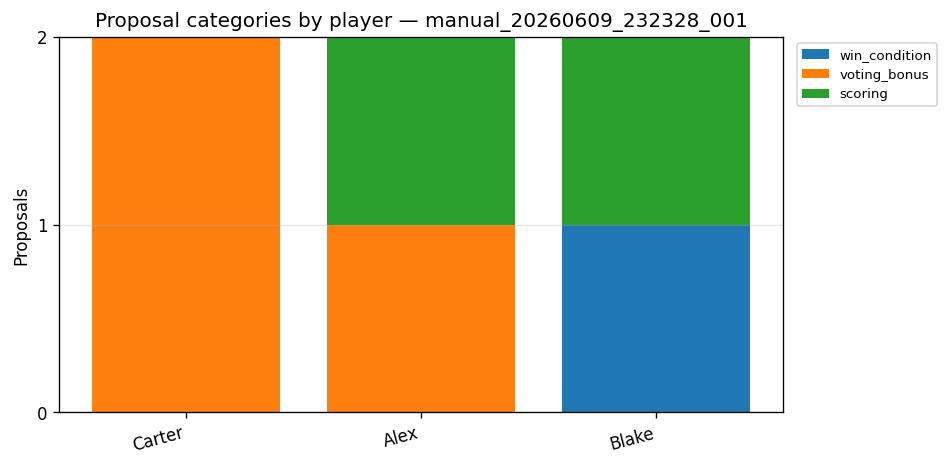
Proposal categories stacked by player

Each player's proposals, broken down by category.

Carter — voting_bonus only

Both proposals raised the yes-vote reward. Framing changes as broadly beneficial made them easy to pass. Both succeeded.

Alex — scoring then voting_bonus

Started with an aggressive proposer-reward doubling (failed). Pivoted to a cooperative yes-vote bonus increase (passed).

Blake — win_condition then scoring

Tried to extend the game via a higher win threshold (failed unanimously). Finished with a proposer-reward increase on the final turn (passed).

Rule evolution

The ruleset stayed stable — M3 changed everything

The total number of rules never changed. All four passed proposals were amendments to existing rules — no additions, no repeals. The real action happened inside rule M3, the scoring rule, which was amended four times.

M3 Evolution — Scoring Rule

Start
Proposer reward: 10 pts · Yes-vote bonus: 0 pts
Turn 1
Yes-vote bonus: 0 → 3 pts Carter passes Participation Bonus
Turn 4
Yes-vote bonus: 3 → 5 pts Carter passes Support Bonus Increase (unanimous)
Turn 5
Yes-vote bonus: 5 → 8 pts Alex passes Boost the Yes-Vote Bonus
Turn 6
Proposer reward: 10 → 15 pts Blake passes Increase the Proposal Reward
End
Proposer reward: 15 pts · Yes-vote bonus: 8 pts Final state — max turn gain: 23 pts
Interpretation

What this shows

Scoring

Scoring became the centre of the game

5 of 6 proposals targeted scoring or voting bonuses. No player attempted to change voting rules, add new rules, or repeal existing ones. Once M3 (the scoring rule) became the focal point, it stayed there.

Cooperation

Cooperation was incentive-driven, not altruistic

Yes-vote bonuses rewarded players financially for supporting passed proposals. This made cooperation individually rational — players voted yes not out of goodwill, but because yes-votes paid.

Stability

Early leads were unstable

Carter led from turn 1 but was ultimately tied on the final turn. The same scoring amendments that Carter used to build a lead also gave opponents the tools to close the gap — particularly the yes-vote bonus that Carter introduced.

Compounding

Small changes compounded quickly

The yes-vote bonus went from 0 to 8 across four turns. By turn 6, a successful proposer who also voted yes on their own proposal could collect 15 + 8 = 23 points in a single turn — more than double the starting proposer reward.

Caveats

Limitations

  • One game, six turns. This is the only completed run. All percentages and patterns are illustrative only — no statistical conclusions should be drawn.
  • Small sample size. With 6 turns and 3 players, even a single vote difference can reverse a percentage.
  • Manual-only run. API automation was not completed because of API authentication and network issues. Every response was pasted in by hand.
  • Heuristic categories. Proposal categories and strategy tags are assigned by keyword matching and mechanical_effects inspection, not expert annotation. They are intentionally transparent and imperfect.
  • Short game dynamics. Six-turn games may favour late proposals, since there is no time to respond to a final-turn move. Longer games may show very different patterns.
  • No cross-model comparison. All three players used different models in a single game, so individual model behaviour cannot be isolated.
Next steps

Future work

  • Run automated API agents. Remove the manual bottleneck and generate many games automatically.
  • Repeat many games. Run 20–50 games to identify patterns that are robust across runs.
  • Compare models under identical conditions. Hold starting rules constant and vary only the model assigned to each player role.
  • Test longer games. 10–20 turns, more players, and more proposal rounds to see how strategies evolve over time.
  • Add richer behavioral metrics. Track vote coalitions, self-interest scores, proposal complexity, and retaliatory voting patterns.
  • Compare manual runs against automated runs. Check whether manual LLM responses differ from API-driven ones in proposal framing or voting strategy.